Any Romanesque Image of Mary Seated on a Throne and Holding the Baby Jesus on Her Lap Is Known as


Our Mother of Perpetual Help, Icon of the Virgin Mary, 16th century. St. Catherine's Monastery in the Sinai.
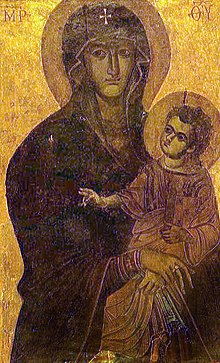
The Salus Populi Romani icon, overpainted in the 13th century, but going back to an underlying original dated to the fifth or sixth century.

A Madonna (Italian: [maˈdɔn.na]) is a representation of Mary, either alone or with her child Jesus. These images are central icons for both the Catholic and Orthodox churches.[1] The discussion is from Italian ma donna 'my lady', albeit archaic. The Madonna and Child type is very prevalent in Christian iconography, divided into many traditional subtypes specially in Eastern Orthodox iconography, often known after the location of a notable icon of the type, such as the Theotokos of Vladimir, Agiosoritissa, Blachernitissa, etc., or descriptive of the depicted posture, as in Hodegetria, Eleusa, etc.
The term Madonna in the sense of "pic or statue of the Virgin Mary" enters English usage in the 17th century, primarily in reference to works of the Italian Renaissance. In an Eastern Orthodox context, such images are typically known as Theotokos. "Madonna" may be generally used of representations of Mary, with or without the babe Jesus, is the focus and key figure of the paradigm, possibly flanked or surrounded by angels or saints. Other types of Marian imagery take a narrative context, depicting scenes from the Life of the Virgin, e.g. the Annunciation to Mary, are not typically called "Madonna".
The primeval depictions of Mary date to Early on Christian art of the (2nd to third centuries, institute in the Catacombs of Rome.[ii] These are in a narrative context. The classical "Madonna" or "Theotokos" imagery develops from the 5th century, as Marian devotion rose to keen importance later on the Quango of Ephesus formally affirmed her status equally "Female parent of God or Theotokos ("God-bearer") in 431.[3] The Theotokos iconography as it developed in the 6th to eighth century rose to great importance in the high medieval period (12th to 14th centuries) both in the Eastern Orthodox and in the Latin spheres.
According to a tradition first recorded in the eighth century, and still strong in the Eastern Church, the iconography of images of Mary goes dorsum to a portrait drawn from life by Luke the Evangelist, with a number of icons (such as the Panagia Portaitissa) claimed to either represent this original icon or to exist a direct copy of it. In the Western tradition, depictions of the Madonna were greatly diversified by Renaissance masters such as Duccio, Leonardo da Vinci, Michelangelo, Raphael, Giovanni Bellini, Caravaggio, and Rubens (and further past certain modernists such as Salvador Dalí and Henry Moore), while Eastern Orthodox iconography adheres more than closely to the inherited traditional types.
Terminology [edit]
Liturgy depicting Mary as powerful intercessor (such as the Akathist) was brought from Greek into Latin tradition in the 8th century. The Greek title of Δεσποινα (Despoina) was adopted as Latin Domina "Lady". The medieval Italian Ma Donna pronounced [maˈdɔnna] ("My Lady") reflects Mea Domina, while Nostra Domina (δεσποινίς ἡμῶν) was adopted in French, every bit Nostre Dame "Our Lady".[4]
These names signal both the increased importance of the cult of the virgin and the prominence of art in service to Marian devotion during the late medieval catamenia. During the 13th century, especially,[ citation needed ] with the increasing influence of knightly and aristocratic culture on verse, song and the visual arts, the Madonna is represented as the queen of Heaven, often enthroned. Madonna was meant more to remind people of the theological concept which is placing such a high value on purity or virginity. This is likewise represented by the color of her wear. The color bluish symbolized purity, virginity, and royalty.[ citation needed ]
While the Italian term Madonna paralleled English Our Lady in tardily medieval Marian devotion, it was imported as an fine art historical term into English usage in the 1640s, designating specifically the Marian art of the Italian Renaissance. In this sense, "a Madonna", or "a Madonna with Kid" is used of specific works of art, historically mostly of Italian works. A "Madonna" may alternatively be chosen "Virgin" or "Our Lady", but "Madonna" is not typically applied to eastern works; e.k. the Theotokos of Vladimir may in English exist called "Our Lady of Vladimir", while it is less usual, but non unheard of, to refer to it as the "Madonna of Vladimir".[v]
Modes of representation [edit]
At that place are several distinct types of representation of the Madonna.
- One blazon of Madonna shows Mary lonely (without the child Jesus), and standing, by and large glorified and with a gesture of prayer, benediction or prophesy. This type of image occurs in a number of aboriginal apsidal mosaics.
- Total-length continuing images of the Madonna more frequently include the infant Jesus, who turns towards the viewer or raises his hand in benediction. The virtually famous Byzantine image, the Hodegetria was originally of this type, though most copies are at half-length. This type of image occurs oft in sculpture and may be found in fragile ivory carvings, in limestone on the cardinal door posts of many cathedrals, and in polychrome wooden or plaster casts in near every Catholic Church. In that location are a number of famous paintings that depict the Madonna in this fashion, notably the Sistine Madonna by Raphael.
- The "Madonna enthroned" is a type of image that dates from the Byzantine period and was used widely in Medieval and Renaissance times. These representations of the Madonna and Kid often have the form of large altarpieces. They besides occur every bit frescoes and apsidal mosaics. In Medieval examples the Madonna is ofttimes accompanied past angels who support the throne, or past rows of saints. In Renaissance painting, particularly High Renaissance painting, the saints may be grouped informally in a type of composition known equally a Sacra conversazione.
- The Madonna of humility refers to portrayals in which the Madonna is sitting on the footing, or sitting upon a low cushion. She may be holding the Child Jesus in her lap.[half dozen] This style was a product of Franciscan piety,[7] [8] and perhaps due to Simone Martini. It spread speedily through Italy and past 1375 examples began to appear in Spain, France and Germany. Information technology was the nearly popular among the styles of the early Trecento artistic period.[ix]
- Half-length Madonnas are the grade most frequently taken by painted icons of the Eastern Orthodox Church, where the subject field matter is highly formulated so that each painting expresses one particular attribute of the "Mother of God". Half-length paintings of the Madonna and Kid are as well common in Italian Renaissance painting, peculiarly in Venice.
- The seated "Madonna and Kid" is a style of image that became particularly popular during the 15th century in Florence and was imitated elsewhere. These representations are usually of a pocket-sized size suitable for a small altar or domestic apply. They usually show Mary belongings the infant Jesus in an informal and maternal style. These paintings often include symbolic reference to the Passion of Christ.
- The "Doting Madonna" is a type pop during the Renaissance. These images, usually small and intended for personal devotion, bear witness Mary kneeling in adoration of the Christ Child. Many such images were produced in glazed terracotta as well as pigment.
- The nursing Madonna refers to portrayals of the Madonna breastfeeding the baby Jesus.
- The iconography of the Adult female of the Apocalypse is applied to marian portraiture in a variety of means over time, depending on the estimation of the relevant Biblical passage.[10]
History [edit]

Painting of the Madonna and Child by an bearding Italian, first half of 19th century
The earliest representation of the Madonna and Kid may be the wall painting in the Catacomb of Priscilla, Rome, in which the seated Madonna suckles the Kid, who turns his caput to gaze at the spectator.[xi]
The earliest consistent representations of Mother and Kid were adult in the Eastern Empire, where despite an iconoclastic strain in culture that rejected physical representations as "idols", respect for venerated images was expressed in the repetition of a narrow range of highly conventionalized types, the repeated images familiar every bit icons (Greek "paradigm"). On a visit to Constantinople in 536, Pope Agapetus was accused of beingness opposed to the veneration of the theotokos and to the portrayal of her image in churches.[12] Eastern examples show the Madonna enthroned, even wearing the closed Byzantine pearl-encrusted crown with pendants, with the Christ Child on her lap.[13]
In the Westward, hieratic Byzantine models were closely followed in the Early on Middle Ages, but with the increased importance of the cult of the Virgin in the 12th and 13th centuries a wide multifariousness of types developed to satisfy a flood of more than intensely personal forms of piety. In the usual Gothic and Renaissance formulas the Virgin Mary sits with the Infant Jesus on her lap, or enfolded in her arms. In before representations the Virgin is enthroned, and the Child may be fully aware, raising his hand to offering blessing. In a 15th-century Italian variation, a baby John the Baptist looks on. The socalled Madonna della seggiola shows both of them: the Virgin embraces the babe Jesus, about John the Baptist.
Tardily Gothic sculptures of the Virgin and Kid may bear witness a standing virgin with the child in her artillery. Iconography varies between public images and private images supplied on a smaller scale and meant for personal devotion in the chamber: the Virgin suckling the Child (such as the Madonna Litta) is an image largely bars to private devotional icons.
Early images [edit]
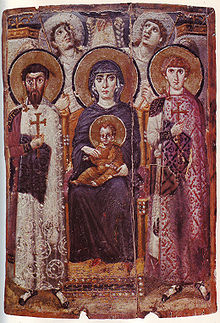
At that place was a swell expansion of the cult of Mary after the Council of Ephesus in 431, when her status equally Theotokos ("God-bearer") was confirmed; this had been a subject area of some controversy until then, though mainly for reasons to do with arguments over the nature of Christ. In mosaics in Santa Maria Maggiore in Rome, dating from 432–440, just after the quango, she is not however shown with a halo, and she is also not shown in Birth scenes at this date, though she is included in the Adoration of the Magi.
By the next century the iconic depiction of the Virgin enthroned carrying the baby Christ was established, as in the example from the only group of icons surviving from this period, at Saint Catherine'south Monastery in Egypt. This blazon of depiction, with subtly irresolute differences of emphasis, has remained the mainstay of depictions of Mary to the present day. The prototype at Mount Sinai succeeds in combining ii aspects of Mary described in the Magnificat, her humility and her exaltation higher up other humans, and has the Hand of God above, up to which the archangels look. An early icon of the Virgin as queen is in the church of Santa Maria in Trastevere in Rome, datable to 705–707 by the kneeling effigy of Pope John Vii, a notable promoter of the cult of the Virgin, to whom the infant Christ reaches his paw. This type was long confined to Rome. The roughly one-half-dozen varied icons of the Virgin and Child in Rome from the 6th–8th century class the majority of the representations surviving from this period; "isolated images of the Madonna and Child ... are and so common ... to the nowadays 24-hour interval in Cosmic and Orthodox tradition, that it is difficult to recover a sense of the novelty of such images in the early Heart Ages, at least in western Europe".[14]
At this period the iconography of the Nativity was taking the grade, centred on Mary, that it has retained upwardly to the present twenty-four hours in Eastern Orthodoxy, and on which Western depictions remained based until the High Eye Ages. Other narrative scenes for Byzantine cycles on the Life of the Virgin were existence evolved, relying on apocyphal sources to fill up in her life before the Proclamation to Mary. By this time the political and economical collapse of the Western Roman Empire meant that the Western, Latin, church was unable to compete in the development of such sophisticated iconography, and relied heavily on Byzantine developments.
The earliest surviving image in a Western illuminated manuscript of the Madonna and Child comes from the Volume of Kells of virtually 800 [xv] (there is a similar carved image on the lid of St Cuthbert's coffin of 698) and, though magnificently decorated in the way of Insular art, the cartoon of the figures tin can just be described as rather crude compared to Byzantine work of the period. This was in fact an unusual inclusion in a Gospel book, and images of the Virgin were slow to announced in large numbers in manuscript fine art until the book of hours was devised in the 13th century.
The Madonna of humility past Domenico di Bartolo, 1433, is considered 1 of the most innovative devotional images from the early Renaissance.[16]
Byzantine influence on the West [edit]
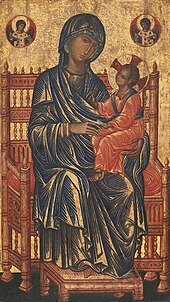
Very few early images of the Virgin Mary survive, though the depiction of the Madonna has roots in ancient pictorial and sculptural traditions that informed the primeval Christian communities throughout Europe, Northern Africa and the Eye East. Of import to Italian tradition are Byzantine icons, peculiarly those created in Constantinople (Istanbul), the majuscule of the longest, enduring medieval civilization whose icons participated in civic life and were celebrated for their miraculous properties. Byzantium (324–1453) saw itself equally the truthful Rome, if Greek-speaking, Christian empire with colonies of Italians living amongst its citizens, participating in Crusades at the borders of its land, and ultimately, plundering its churches, palaces and monasteries of many of its treasures. Later in the Middle Ages, the Cretan school was the main source of icons for the Westward, and the artists there could conform their fashion to Western iconography when required.
While theft is one manner that Byzantine images fabricated their way W to Italy, the human relationship between Byzantine icons and Italian images of the Madonna is far more rich and complicated. Byzantine art played a long, disquisitional role in Western Europe, especially when Byzantine territories included parts of Eastern Europe, Greece and much of Italia itself. Byzantine manuscripts, ivories, aureate, argent and luxurious textiles were distributed throughout the Due west. In Byzantium, Mary'due south usual title was the Theotokos or Mother of God, rather than the Virgin Mary and information technology was believed that salvation was delivered to the faithful at the moment of God'south incarnation. That theological concept takes pictorial form in the image of Mary holding her babe son.
Even so, what is near relevant to the Byzantine heritage of the Madonna is twofold. Beginning, the earliest surviving independent images of the Virgin Mary are institute in Rome, the center of Christianity in the medieval Due west. Ane is a valued possession of Santa Maria in Trastevere, i of the many Roman churches defended to the Virgin Mary. Another, a splintered, repainted ghost of its former self, is venerated at the Pantheon, that groovy architectural wonder of the Ancient Roman Empire, that was rededicated to Mary every bit an expression of the Church's triumph. Both evoke Byzantine tradition in terms of their medium, that is, the technique and materials of the paintings, in that they were originally painted in tempera (egg yolk and ground pigments) on wooden panels. In this respect, they share the Ancient Roman heritage of Byzantine icons. Second, they share iconography, or subject matter. Each epitome stresses the maternal role that Mary plays, representing her in relationship to her baby son. It is hard to gauge the dates of the cluster of these earlier images, however, they seem to exist primarily works of the seventh and 8th centuries.
Afterward medieval period [edit]
It was not until the revival of awe-inspiring panel painting in Italy during the 12th and 13th centuries, that the epitome of the Madonna gains prominence outside of Rome, specially throughout Tuscany. While members of the mendicant orders of the Franciscan and Dominican Orders are some of the starting time to commission panels representing this subject field matter, such works speedily became pop in monasteries, parish churches, and homes. Some images of the Madonna were paid for by lay organizations chosen confraternities, who met to sing praises of the Virgin in chapels found inside the newly reconstructed, spacious churches that were sometimes defended to her. Paying for such a piece of work might besides be seen as a form of devotion. Its expense registers in the use of thin sheets of existent gilt leaf in all parts of the panel that are not covered with pigment, a visual counterpart not only to the costly sheaths that medieval goldsmiths used to decorate altars, simply also a ways of surrounding the paradigm of the Madonna with illumination from oil lamps and candles. Even more than precious is the vivid bluish pall colored with lapis lazuli, a rock imported from Transitional islamic state of afghanistan.
This is the case of ane of the nigh famous, innovative and awe-inspiring works that Duccio executed for the Laudesi at Santa Maria Novella in Florence. Ofttimes the calibration of the work indicates a bully deal virtually its original function. Often referred to as the Rucellia Madonna (c. 1285), the panel painting towers over the spectator, offering a visual focus for members of the Laudesi confraternity to get together before it as they sang praises to the prototype. Duccio made an even grander image of the Madonna enthroned for the loftier altar of the cathedral of Siena, his home boondocks. Known every bit the Maesta (1308–1311), the epitome represents the pair every bit the center of a densely populated court in the central part of a complexly carpentered piece of work that lifts the court upon a predella (pedestal of altarpiece) of narrative scenes and standing figures of prophets and saints. In turn, a modestly scaled image of the Madonna every bit a half-length figure holding her son in a memorably intimate depiction, is to be constitute in the National Gallery of London. This is clearly made for the private devotion of a Christian wealthy enough to hire one of the well-nigh important Italian artists of his day.
The privileged possessor demand not go to Church to say his prayers or plead for salvation; all he or she had to do was open the shutters of the tabernacle in an act of private revelation. Duccio and his contemporaries inherited early pictorial conventions that were maintained, in part, to tie their own works to the authority of tradition.
Despite all of the innovations of painters of the Madonna during the 13th and 14th centuries, Mary tin can usually be recognized by virtue of her attire. Customarily when she is represented as a youthful mother of her newborn kid, she wears a deeply saturated blue drape over a red garment. This mantle typically covers her head, where sometimes, i might see a linen, or later on, transparent silk veil. She holds the Christ Child, or Baby Jesus, who shares her halo as well as her regal bearing. Oft her gaze is directed out at the viewer, serving equally an intercessor, or conduit for prayers that flow from the Christian, to her, and simply and so, to her son. However, late medieval Italian artists also followed the trends of Byzantine icon painting, developing their own methods of depicting the Madonna. Sometimes, the Madonna'due south complex bond with her tiny child takes the form of a close, intimate moment of tenderness steeped in sorrow where she only has optics for him.
While the focus of this entry currently stresses the depiction of the Madonna in panel painting, her image too appears in mural decoration, whether mosaics or fresco painting on the exteriors and interior of sacred buildings. She is found high above the apse, or east terminate of the church building where the liturgy is celebrated in the Westward. She is also found in sculpted class, whether small ivories for private devotion, or large sculptural reliefs and free-standing sculpture. As a participant in sacred drama, her image inspires ane of the most important fresco cycles in all of Italian painting: Giotto's narrative bicycle in the Arena Chapel, next to the Scrovegni family'southward palace in Padua. This program dates to the first decade of the 14th century.
Italian artists of the 15th century onward are indebted to traditions established in the 13th and 14th centuries in their representation of the Madonna.
Renaissance [edit]
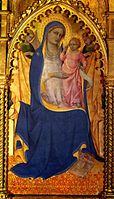
While the 15th and 16th centuries were a time when Italian painters expanded their repertoire to include historical events, independent portraits and mythological discipline matter, Christianity retained a strong hold on their careers. Most works of art from this era are sacred. While the range of religious subject matter included subjects from the One-time Testament and images of saints whose cults date after the codification of the Bible, the Madonna remained a dominant subject field in the iconography of the Renaissance.
Some of the most eminent 16th-century Italian painters to turn to this subject field were Leonardo da Vinci, Michelangelo, Raphael,[note ane] Giorgione, Giovanni Bellini and Titian. They developed on the foundations of 15th-century Marian images by Fra Angelico, Fra Filippo Lippi, Mantegna and Piero della Francesca in detail, amid countless others. The field of study was equally popular in Early Netherlandish painting and that of the residual of Northern Europe.
The discipline retaining the greatest ability on all of these men remained the maternal bond, even though other subjects, particularly the Annunciation, and later the Immaculate Conception, led to a greater number of paintings that represented Mary lone, without her son. As a commemorative image, the Pietà became an important subject field, newly freed from its former part in narrative cycles, in part, an outgrowth of popular devotional statues in Northern Europe. Traditionally, Mary is depicted expressing compassion, grief and honey, usually in highly charged, emotional works of art even though the most famous, early piece of work by Michelangelo stifles signs of mourning. The tenderness an ordinary female parent might feel towards her beloved child is captured, evoking the moment when she first held her infant son Christ. The spectator, after all, is meant to sympathize, to share in the despair of the female parent who holds the body of her crucified son.

Modern images [edit]
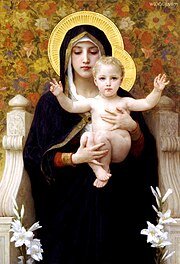
In some European countries, such every bit Germany, Italia and Poland sculptures of the Madonna are found on the outside of city houses and buildings, or along the roads in modest enclosures.
In Germany, such a statue placed on the outside of a edifice is called a Hausmadonna. Some date back to the Center Ages, while some are still being fabricated today. Usually found on the level of the second flooring or higher, and oftentimes on the corner of a house, such sculptures were found in nifty numbers in many cities; Mainz, for instance, was supposed to take had more than 200 of them before World War II.[nineteen] The diverseness in such statues is as great equally in other Madonna images; i finds Madonnas holding grapes (in reference to the Song of Songs i:fourteen, translated as "My lover is to me a cluster of henna blossoms" in the NIV), "immaculate" Madonnas in pure, perfect white without child or accessories, and Madonnas with roses symbolizing her life determined by the mysteries of faith.[xx]
In Italia, the roadside Madonna is a common sight both on the side of buildings and along roads in small enclosures. These are expected to bring spiritual relief to people who pass them.[21] Some Madonnas statues are placed around Italian towns and villages equally a matter of protection, or as a commemoration of a reported miracle.[22]
In the 1920s, the Daughters of the American Revolution placed statues chosen the Madonna of the Trail from declension to declension, marking the path of the old National Road and the Santa Fe Trail.[23]
Throughout his life, the painter Ray Martìn Abeyta created works inspired by the Cusco School style of Madonna painting, creating a hybrid of traditional and gimmicky Latino subject field affair representing the colonialist encounters between Europeans and Mesoamericans.[24] [25]
In 2015 iconographer Mark Dukes created the icon Our Lady of Ferguson, depicting the Madonna and kid, in relation to the Shooting of Michael Chocolate-brown in Ferguson, Missouri.[26]
Islamic view [edit]

The first of import meet between Islam and the image of the Madonna is said to take happened during the Prophet Muhammad's conquest of Mecca. At the culmination of his mission, in 629 CE, Muhammad conquered Mecca with a Muslim army, with his commencement action being the "cleansing" or "purifying" of the Kaaba, wherein he removed all the pre-Islamic pagan images and idols from inside the temple. According to reports collected by Ibn Ishaq and al-Azraqi, Muhammad did, however, protectively put his hand over a painting of Mary and Jesus, and a fresco of Abraham in order to keep them from being effaced.[27] [28] In the words of the historian Barnaby Rogerson, "Muhammad raised his hand to protect an icon of the Virgin and Child and a painting of Abraham, but otherwise his companions cleared the interior of its clutter of votive treasures, cult implements, statuettes and hanging charms."[29]
The Islamic scholar Martin Lings narrated the event thus in his biography of the Prophet: "Christians sometimes came to do honour to the Sanctuary of Abraham, and they were made welcome like all the residuum. Moreover one Christian had been allowed and even encouraged to paint an icon of the Virgin Mary and the child Christ on an inside wall of the Ka'bah, where it sharply contrasted with all the other paintings. But Quraysh were more or less insensitive to this contrast: for them it was but a question of increasing the multitude of idols by another two; and it was partly their tolerance that made them and then impenetrable.... Apart from the icon of the Virgin Mary and the kid Jesus, and a painting of an onetime homo, said to be Abraham, the walls within had been covered with pictures of pagan deities. Placing his hand protectively over the icon, the Prophet told Uthman to see that all the other paintings, except that of Abraham, were effaced."[xxx]
Notable types and individual works [edit]

There are a large number of articles on individual works of various sorts in Category:Virgin Mary in art and its sub-category. See too the incomplete List of depictions of the Virgin and Child. The term "Madonna" is often applied to representations of Mary that were not created by Italians. A small selection of examples include:
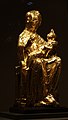
- Gold Madonna of Essen, the earliest big-calibration sculptural example in Western Europe and a precedent for the polychrome wooden processional sculptures of Romanesque France, a blazon known as Throne of Wisdom.
- Madonna of humility depicting a Madonna sitting on the ground, or low cushions
- Madonna and Child, a painting by Duccio di Buoninsegna, from effectually the year 1300.
- The Blackness Madonna of Częstochowa (Czarna Madonna or Matka Boska Częstochowska in Shine) icon, which was, according to legend, painted by St. Luke the Evangelist on a cypress table height from the house of the Holy Family.
- Madonna and Child with Flowers, possibly ane of two works begun past Leonardo da Vinci.
- Madonna Eleusa (of tenderness) has been depicted both in the Eastern and Western churches.
- Madonna of the Steps, a relief by Michelangelo.
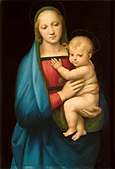
- Madonna della seggiola, by Raphael
- Madonna with the Long Neck, by Parmigianino.
- The Madonna of Port Lligat, the name of ii paintings by Salvador Dalí created in 1949 and 1950.
Paintings [edit]
- Madonna in Art
-

Madonna in Mandorla, Wolfgang Sauber, twelfth century
-
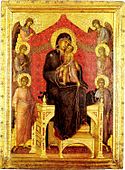
Madonna and Angels, Duccio, 1282
-

Our Mother of Perpetual Help, probably an early on Cretan piece of work, 13th or 14th century. A very pop Catholic prototype, which was certainly in Rome past 1499.
-

Mary and the child depicted as a hodegetria. Tesselated icon in monumental fashion, early 13th century. Saint Catherine'due south Monastery in the Sinai, Arab republic of egypt
-

Madonna in the rose-garden, by Stefan Lochner 1448
-

-
-

-

-

-

Statues [edit]
-

Egyptian ivory carving, 1 of the earliest examples of what in later Byzantine times was called Eleousa, or "Virgin of Tenderness". seventh century.
-
-
-

-

A roadside Madonna in Ocieka, Poland.
-

A roadside Madonna apse in Friuli, Italia.
-
-

Manuscripts and covers [edit]
See besides [edit]
- Christian Fine art
- Art in Roman Catholicism
- Mary (mother of Jesus)
- Roman Cosmic Marian fine art
- Pietà
- Nursing Madonna
- Life-giving Spring
- Eleusa icon
- Theotokos
- Icon of the Hodegetria
- Our Lady of Guadalupe
- La Conquistadora
Notes [edit]
- ^ According to Westward. H. Wackenroder, some writings by Bramante reveal that Raphael told him that he discovered how to paint his Madonnas in a visionary dream he had after praying to the Virgin.[18]
References [edit]
- ^ Doniger, Wendy, Merriam-Webster'due south encyclopedia of world religions, 1999, ISBN 0-87779-044-two p. 696.
- ^ Mary in Western Fine art by Timothy Verdon, Filippo Rossi 2005 ISBN 0-9712981-ix-X p. 11
- ^ Burke, Raymond, Mariology: A Guide for Priests, Deacons, Seminarians, and Consecrated Persons 2008 ISBN one-57918-355-7[ page needed ]
- ^ Johannes Schneider, Virgo Ecclesia Facta, 2004, p. 74. Michael O'Carroll, Theotokos: A Theological Encyclopedia of the Blessed Virgin Mary, 2000, p. 127.
- ^ "Madonna of Vladimir" e.k. in Hans Belting, Edmund Jephcott; Edmund Jephcott (trans.) Likeness and Presence: A History of the Image Earlier the Era of Fine art, University of Chicago Press, 1996, p. 289.
- ^ Renaissance fine art: a topical dictionary by Irene Earls 1987 ISBN 0-313-24658-0 p. 174
- ^ A history of ideas and images in Italian fine art by James Hall 1983 ISBN 0-06-433317-v p. 223
- ^ Iconography of Christian Art by Gertrud Schiller, 1971 ASIN B0023VMZMA p. 112
- ^ Painting in Florence and Siena after the Black Death by Millard Meiss 1979 ISBN 0-691-00312-2 pp. 132–133
- ^ Roten, Johann. "Crescent Moon: Meaning : University of Dayton, Ohio". udayton.edu.
- ^ Victor Lasareff, "Studies in the Iconography of the Virgin" The Art Bulletin xx.1 (March 1938, pp. 26–65 [pp. 27f]).
- ^ m. Mundell, "Monophysite church ornamentation" Iconoclasm (Birmingham) 1977, p. 72.
- ^ As in the fresco fragments of the lower Basilica di San Clemente, Rome: see John L. Osborne, "Early Medieval Painting in San Clemente, Rome: The Madonna and Child in the Niche" Gesta xx.2 (1981), pp. 299–310.
- ^ Nees, Lawrence. Early medieval fine art, 143–145, quote 144, Oxford University Press, 2002, ISBN 0-19-284243-nine, ISBN 978-0-19-284243-5
- ^ Werner, Martin (1972). "The Madonna and Child Miniature in the Book of Kells: Part I". The Art Bulletin. 54 (i): 1–23. doi:ten.2307/3048928. JSTOR 3048928.
- ^ Art and music in the early on modern menstruum past Franca Trinchieri Camiz, Katherine A. McIver ISBN 0-7546-0689-9 p. 15 [1]
- ^ National Gallery of Art, Washington D.C.
- ^ Salmi, Mario; Becherucci, Luisa; Marabottini, Alessandro; Tempesti, Anna Forlani; Marchini, Giuseppe; Becatti, Giovanni; Castagnoli, Ferdinando; Golzio, Vincenzo (1969). The Complete Work of Raphael. New York: Reynal and Co., William Morrow and Company. p. 622.
- ^ Wöhrlin, Annette; Luzie Bratner; Marlene Höbel; Hiltraud Laubach; Anne-Madeleine Plum (2008). Mainzer Hausmadonnen. Ingelheim: Leinpfad. ISBN978-3-937782-seventy-six.
- ^ Anne-Madeleine Plum, "Kreuzzepter-Madonna--Zypertraube ind fruchtbringende Rede" and "Maria, Geheimnisvolle Rose", in Wöhrlin, Mainzer Hausmadonnen, pp. 49–54, 55–57.
- ^ Thomas Singer, 2004 The cultural complex ISBN 1-58391-913-9 p. 68
- ^ Mark Pearson, 2006 Italy from a Backpack ISBN 0-9743552-four-0 p. 219
- ^ Madonna of the Trail
- ^ Williams, Stephen P. (August 5, 2007). "The Art Is Striking, so Are the Cars". The New York Times . Retrieved 9 April 2019.
- ^ Roberts, Kathaleen (June 29, 2014). "NM History Museum unveils rare colonial paintings of Mary". Albuquerque Journal . Retrieved nine April 2019.
- ^ http://nebraskaepiscopalian.org/?cat=32&paged=2
- ^ Guillaume, Alfred (1955). The Life of Muhammad. A translation of Ishaq's "Sirat Rasul Allah". Oxford Academy Press. p. 552. ISBN978-0196360331 . Retrieved 2011-12-08 .
Quraysh had put pictures in the Ka'ba including ii of Jesus son of Mary and Mary (on both of whom be peace!). ... The apostle ordered that the pictures should be erased except those of Jesus and Mary.
- ^ Ellenbogen, Josh; Tugendhaft, Aaron (2011). Idol Anxiety. Stanford Academy Press. p. 47. ISBN978-0804781817.
When Muhammad ordered his men to cleanse the Kaaba of the statues and pictures displayed there, he spared the paintings of the Virgin and Child and of Abraham.
- ^ Rogerson, Barnaby (2003). The Prophet Muhammad: A Biography. Paulist Press. p. 190. ISBN978-1587680298.
- ^ Martin Lings, Muhammad: His Life Based on the Earliest Source (Rochester: Inner Traditions, 1987), pp. 17, 300.
External links [edit]
- Metropolitan Museum: The Virgin Mary in the Middle Ages
- The Madonna in Art at Project Gutenberg past Estelle 1000. Hurll (Outset printed 1897)
Source: https://en.wikipedia.org/wiki/Madonna_%28art%29
0 Response to "Any Romanesque Image of Mary Seated on a Throne and Holding the Baby Jesus on Her Lap Is Known as"
Post a Comment